Last week in English class, a student told me she was having trouble reading
Hamlet on her own. She had been absent for an extended period of time due to mononucleosis and the class had finished the play without her, but she still needed to write her final
Hamlet essay. And I'm not the kind of teacher that offers to stay after school and help. Instead, I advised her to watch the movie. The girl sitting in front of her, who was eavesdropping, was appalled. "You're telling her to watch the movie instead of reading the book? And you call yourself an English teacher?"
Normally, an insubordinate comment like this from a student would require some sort of disciplinary action, but not in this case. Why not? Because this particular girl is a passionate reader and a frequent participator in class discussions. Not only that, she's extremely short. So short, that like Rob, she gets away with murder. She was so frustrated on her last
Hamlet quiz that by the time she got to the bonus question, which she did not know, she wrote:
I don't give a shit. Expel me. She knew that because of her diminutive stature she could get away with it. She did. I laughed.
I said to them both: "The movie
is the book . . . it's not a novel. It's a
play." The girl who needed to make up the essay was fine with this.
"Which one should I watch," she asked.
"The Kenneth Branagh," I said.
The other girl wouldn't give up: "She can't just watch the movie! You made us read it first!"
I explained to the short, contrary girl that I wanted the class to imagine how to act and direct the scenes before they saw a film interpretation, but that it wasn't absolutely necessary to understanding the play. In fact, I admitted, if you just need to comprehend Shakespeare, you're far better off seeing professionals do it on a stage. The script is simply Shakespeare's blueprint for making a play.
I asked her if she read the screenplay for
The Hangover before she watched the movie. She remained unconvinced, questioned my dedication to my profession, told me I had no respect for literature, and then went back to eating her salami sandwich. (Each and every day, this tiny little girl eats a salami sandwich in my class; I allow snacking as long as there is no sharing of the food. In my experience, snackers are generally better students: they are planners and they keep their glucose levels up, which is what your brain needs in order to think-- but apparently our principal does not believe this, as he recently made an announcement reminding students and staff that there should be no food or drink other than water in the classroom. Rumor has it that there has been an invasion of mice. I told salami-sandwich girl she would have to be discreet with her sandwich, and if the principal walked in, she'd have to stuff it into her purse ASAP. Again, how do you tell someone that small that they can't eat?)
Despite her arguments, I still believe that a play is written to be performed; you don't need to read it first in order to appreciate it. But this debate opens an interesting can of worms. We have limited time in our lives. Sometimes we have to choose whether we are going to read something or watch it. Sometimes we don't have the time and the patience to do both.
Occasionally . . . miraculously . . . a movie or TV show perfectly captures the tone, theme, and plot of a book so perfectly, that you could say that it is a substitute for the written version. You could either read it or watch it, but you don't need to do both. HBO's
Game of Thrones is an example of this. The books are excellent, the show is excellent . . . and the show is like the books. Take your pick. You could probably make the same argument for
The Walking Dead. Great comic books, great show. I'd say the same about
Watchmen, but then Alan Moore would come to my house and tear me to shred with his talons, so I won't.
Generally, the movie doesn't live up to the book. There is no bigger
cliché than: "the book was better."
The Hunger Games recently disappointed me in this fashion, but I can't say I was surprised. Igor recently explained why book to movie transformations rarely meet expectations:
Characterization, back-story, and thorough explanation are almost always the elements of a book left behind when transferred to film. Even The Shining, which Kubrick made one of the most truly terrifying cinematic creations out of (and gave me nightmares), couldn't approach the level of bone-chilling detail, explanation of paranormal activity, and contextual understanding for characters both major and bit that came through in King's book.
The most interesting and controversial category is when the movie is actually better than the book. And we're not talking about gimmes, which this
stupid list is full of. Yes, I believe you when you tell me that
Full Metal Jacket is better than
The Short Timers.
This
stupid list also makes the bold claim that
There Will Be Blood is better than Upton Sinclair's
Oil! It goes out on a limb and says the same about
The Princess Bride,
Wild at Heart,
The Prestige, and
Requiem For a Dream. None of these are classic works of fiction. None of these are must reads. So my comment is: So what? I'm certainly watching
The Princess Bride before I read it, and I'm not feeling like I missed anything.
The
stupid list has
fifty movies that are better than the book, and there's generally no explanation as to why this is so. They have essentially listed any movie based on a book that isn't a piece of crap, without qualifying their opinion. The movie version of
The Talented Mr. Ripley is decent-- a reasonably good thriller-- but it barely scratches the surface of Patricia Highsmith's masterpiece.
Trainspotting, Bladerunner, and
The Maltese Falcon . . . these are at least debatable-- but on the
stupid list there is no debate until the top ten, and even then it's superficial. As much as I love the Coen Brothers, they are no match for Cormac McCarthy and his crime novel
No Country For Old Men. And James Ellroy may be the best crime writer of our generation, so though
L.A. Confidential is good, it's not
better than the book. It doesn't
replace reading James Ellroy. And they have the balls to say that
Apocalypse Now is better than
Heart of Darkness. Philistines. Both are great works of art, but they are both incomparably great. You need to consume both of them. I am wondering if the people who made this list actually read any of these books . . . or if they watch so many movies that they don't have time to read at all.
So which movies are definitely better than the books upon which they were based? And we're talking about classic books, highly recommended books. Good books. Books you might actually read. And this means that you have to choose. Book or movie, and you can never go back and read or watch the other. So, with everything on the line, which movies sincerely supersede the book?
7) The Godfather, of course. No insult to Mario Puzo and his excellent, though melodramatically written novel, but seeing is believing . . . and Coppola's
The Godfather looks like a documentary, despite Marlon Brando's wacky performance. You never forget the scenes, the characters, and even the quality of light in the film. A no-brainer.
6) One Flew over the Cuckoo's Nest. The book is great, but dated, and the psychedelic narration gets tiresome. Jack Nicholson and Danny Devito actually
act in this movie-- they haven't become typecast as cartoon versions of themselves yet, and that makes it unmissable.
5) Lord of the Rings. Nothing puts you to sleep quicker than reading Tolkien's masterwork. It is epic, but rather tedious, with jests, but no jokes. One of my students created
the perfect metaphor to describe reading it. Peter Jackson's adaptation is epic
and entertaining . . . there's no comparison.
4) A Clockwork Orange. A weird, fun, and challenging novel, but Stanley Kubrick used it as a blueprint for one of the most visually arresting films ever.
3) Jaws. Peter Benchley is really good at writing about sharks. I enjoyed his non-fiction book
Shark Trouble: True Stories and Lessons About the Sea as much as
Jaws. But that stupid mechanical shark coupled with the most memorable theme song ever (a meme song?) will always trump Benchley's writing. Plus, you can't beat Richard Dreyfuss as Hooper.
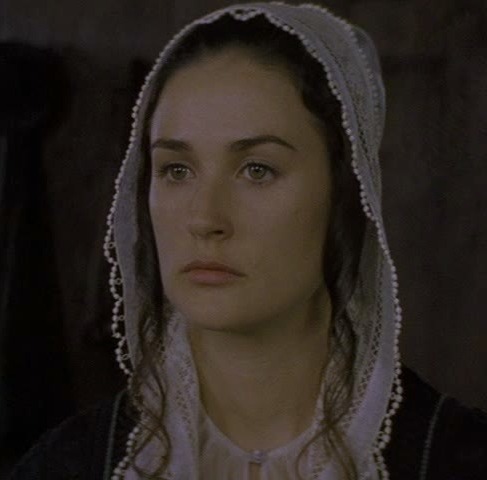
2) The Scarlet Letter. Nathaniel Hawthorne's classic story of Puritan America suffers from an overload of Gothic bombast, but Demi Moore brings a wonderful sensibility to Hester Prynne's alienation . . . HA! JUST KIDDING! The movie version is horrible . . . atrocious . . . an insult to the original . . . but you do get to see Demi Moore wear a funny hat
and get buck-naked in an old bathtub.
1) Lord of the Flies. William Golding creates an archetypal story of what happens to civilization when the rules are stripped away, but to get to the meat of the story, you've got to wade through pages and pages of monotonous description . . . tendrils and creepers and vines, oh my! When I taught this thing, we skipped chapters. The black and white movie, however, is perfect. Watch it and I promise you will wish you never read the book.
So what have we learned? First of all,
books are great . . . I'm the first one to admit that. But if you get a first rate director, the proper casting, some truly inspired acting, and a tight script . . . and these come together in exactly the right way, then there's no question that a picture is worth a thousand words . . . nothing is more memorable than a great movie. And that's coming from an English teacher. And think of the time you'll save!






 Posts
Posts

